

Thinking about the future can feel overwhelming, especially when legal terms like ‘Enduring’ and ‘General’ start to cloud the picture. It’s natural to worry about who will manage your affairs if you’re no longer able, and to fear that your personal wishes for your health and finances might be misunderstood. The process of setting up a power of attorney can seem daunting, leaving many people in Queensland unsure where to even begin.
We understand these concerns, and this guide is designed to provide the clarity and reassurance you need. We will walk you through what a Power of Attorney is, why it’s one of the most vital documents for protecting your future, and how to confidently choose the right person for this important role. Our goal is to empower you with the knowledge to ensure your affairs are managed correctly, making a difficult time easier for your loved ones and giving you lasting peace of mind.
What is a Power of Attorney? (And Why It’s Not Just for the Elderly)
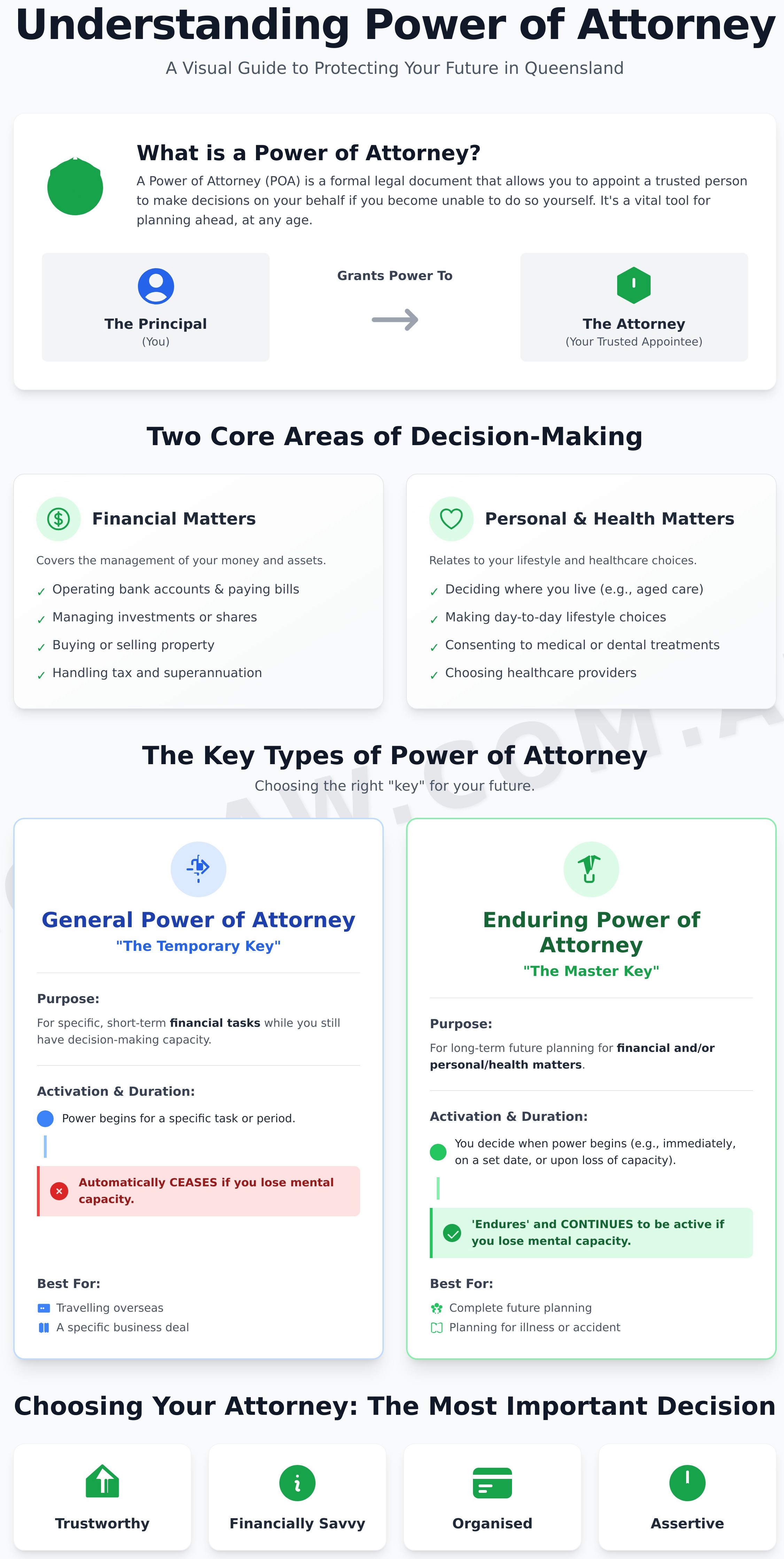
We understand that planning for the future can feel complex, but creating a Power of Attorney is one of the most empowering and practical steps you can take to protect your interests. In simple terms, a Power of attorney is a formal legal document that lets you appoint a trusted person to make decisions on your behalf if you are unable to. In this arrangement, you are the ‘Principal’, and the person you appoint is your ‘Attorney’. It’s a tool for planning ahead, giving you control over who manages your affairs, not a sign of giving up your independence.
A common misconception is that this document is only for the elderly. However, life is unpredictable. A sudden illness or a serious accident could temporarily prevent anyone, at any age, from managing their own finances or making healthcare choices. Having a plan in place provides clear guidance and profound peace of mind, ensuring your wishes are respected and your responsibilities are met during a difficult time.
The Two Core Areas of Decision-Making
In Queensland, an Enduring Power of Attorney allows your chosen person to make decisions across two key areas of your life. You can appoint the same person for both, or choose different people for each role:
- Financial Matters: This covers managing your finances, such as operating bank accounts, paying bills, managing investments, or buying and selling property on your behalf.
- Personal and Health Matters: This relates to lifestyle decisions, including where you live, who you see, and what healthcare or medical treatments you receive.
Why a ‘Handshake Agreement’ with Family Isn’t Enough
While you may trust your family implicitly, an informal agreement simply doesn’t hold up when legal authority is required. Banks, government agencies, and medical professionals need a legally valid document to grant your loved one access to your accounts or information. A formal power of attorney removes any ambiguity. It provides a clear, legally-binding instruction that prevents potential disagreements among family members during an already stressful period and offers legal protection for both you and your appointed attorney.
The Key Types of Power of Attorney in Queensland
Understanding the different types of Power of Attorney available in Queensland is the first step toward making an informed decision. We understand that legal documents can feel complex, but the core difference is straightforward. The right choice depends entirely on your unique circumstances and what you want to achieve.
Think of it like giving someone a key to your affairs. A General Power of Attorney is like a temporary key you give someone for a specific, short-term purpose. An Enduring Power of Attorney is a master key you entrust to someone for the long term, ensuring they can help you even if you lose the ability to manage things yourself.
General Power of Attorney (GPA)
A General Power of Attorney is a practical tool for short-term needs. You appoint someone to make financial decisions on your behalf for a specific period or task, while you still have the full mental capacity to oversee them. Common situations include authorising someone to manage your bank accounts while you are travelling overseas or signing contracts for you during a temporary illness. Crucially, a GPA automatically ceases to have any power if you lose mental capacity.
Enduring Power of Attorney (EPOA)
This is the most comprehensive and common form of power of attorney for future planning. Its key feature is that it ‘endures’-or continues-to be effective even if you lose the capacity to make your own decisions. You can decide when your attorney’s power begins: immediately, on a specific future date, or only after a medical professional deems you have lost capacity. Because it provides long-term security, it’s essential this document is prepared correctly using the official Queensland Government forms and with professional guidance.
A Note on Advance Health Directives (AHD)
While often discussed alongside EPOAs, an Advance Health Directive is a separate, specific legal document. It allows you to give legally binding directions about your future medical care and treatment, including the refusal of particular treatments. It works hand-in-hand with an EPOA for personal and health matters, where your attorney can make health decisions for you on any issue not covered by your AHD.
Quick Comparison: GPA vs. EPOA
- Purpose:
- GPA: For specific, temporary financial tasks.
- EPOA: For long-term future planning for financial and/or personal/health matters.
- When it Ends:
- GPA: When you revoke it, upon recovery, or automatically if you lose mental capacity.
- EPOA: When you revoke it (while you have capacity) or upon your death. It continues if you lose capacity.
- Best For:
- GPA: Travelling, temporary physical incapacity, a specific business deal.
- EPOA: Planning for potential future incapacity due to age, illness, or accident.
Choosing Your Attorney: The Most Important Decision You’ll Make
Selecting the person to act as your attorney is arguably the most critical step in creating a power of attorney. This decision should be based on absolute trust, not simply on family obligation or tradition. You are granting someone immense authority over your personal and financial affairs, so it is vital to choose a person who you are confident will always act in your best interests. Legally, your chosen attorney must be over 18 years of age and have full legal capacity themselves.
Qualities of a Good Attorney
We understand that this can feel like a difficult choice. Look for someone who demonstrates the following qualities, as they will be responsible for upholding your wishes with integrity and care:
- Unquestionable Trustworthiness: This is the foundation of the role. The person must be honest, reliable, and committed to protecting your interests above all else.
- Good Organisational Skills: For financial matters, your attorney will need to manage accounts, pay bills, and keep accurate records. Someone who is organised and financially literate is essential.
- Willingness and Understanding: Your chosen person must willingly accept the responsibility. It is also crucial that they understand your values, beliefs, and personal wishes, and are prepared to advocate for them.
Before making your final decision, have an open and honest conversation with your potential attorney. Ensure they understand the role and are comfortable accepting the significant responsibility it entails.
Appointing More Than One Attorney
In Queensland, you can appoint more than one person to manage your affairs. You can structure this appointment in a few ways:
- Jointly: All attorneys must make decisions together and must all sign documents. This provides a safeguard but can be impractical if they disagree or one becomes unavailable.
- Severally: Attorneys can make decisions independently of one another. This is more flexible but requires complete trust that they will communicate effectively.
Regardless of your choice, we strongly recommend appointing an alternative attorney. This ensures someone you trust can step in if your first choice is unable or unwilling to act when needed.
Who You Should NOT Appoint
Carefully consider any potential issues before appointing someone. It is wise to avoid choosing:
- Someone with a Conflict of Interest: Avoid appointing a person who may stand to benefit financially from the decisions they make on your behalf.
- A Paid Carer: In most circumstances, QLD law restricts a person’s paid carer or health provider from being appointed as their attorney.
- Someone Out of Obligation: Never appoint a person because you feel pressured or obligated to. This decision must be yours alone, made with complete confidence and peace of mind.
The Responsibilities and Legal Duties of an Attorney
We understand that appointing someone to manage your affairs is a significant act of trust. It’s natural to feel concerned about how that power will be used. Fortunately, Queensland law places strict and legally binding obligations on anyone acting under a power of attorney to ensure they protect you and your interests.
The core duty of an attorney is to always act in the principal’s best interests. This is more than just a guideline; it is an enforceable legal standard. This includes avoiding any ‘conflict transactions’ where their own interests might clash with yours, and maintaining detailed, accurate records of all decisions and transactions made on your behalf. Good record-keeping is not just good practice-it is a legal requirement.
What Your Attorney Can and Cannot Do
An attorney’s authority is powerful, but it has clear boundaries defined by law and the document itself. While their specific powers depend on what you authorise, their general scope includes:
- What they can do: Pay your bills, manage your bank accounts and investments, buy or sell property on your behalf, and make decisions about your living arrangements and daily care (if you have granted them personal/health powers).
- What they cannot do: Make or change your Will, vote in an election for you, act against any lawful instructions you have given, or use their position for personal profit unless you have specifically authorised a benefit.
The Principle of Substituted Judgment
When making a decision for you, your attorney must apply the principle of ‘substituted judgment’. In simple terms, this means they must try to stand in your shoes and make the decision you would have made for yourself if you had the capacity. This requires them to consider your previously expressed views, values, and beliefs. It highlights why having open and honest conversations with your chosen attorney about your wishes is so important for the future.
What Happens if an Attorney Acts Improperly?
Queensland has a robust system in place to provide a safety net. If there are serious concerns that an attorney is not fulfilling their duties or is acting improperly, an application can be made to the Queensland Civil and Administrative Tribunal (QCAT). QCAT has the authority to investigate an attorney’s actions, demand they produce financial records, and if necessary, suspend or permanently remove them from their role. This oversight provides peace of mind that your interests are protected.
How to Create a Valid Power of Attorney in Queensland
We understand that creating a legal document can feel daunting. While the process for establishing a power of attorney in Queensland follows a set procedure, the legal requirements are strict and must be followed precisely. Ensuring the document is valid and enforceable when you need it most is critical. Getting it right from the start provides peace of mind and protects your interests down the track.
Completing the Official Forms
The essential first step is to use the correct, up-to-date Queensland Government-approved form. For an Enduring Power of Attorney (EPOA), you can choose between a ‘short form’ for straightforward appointments or a ‘long form’ that allows for more detailed instructions and conditions. Every section must be completed with absolute clarity. Any vague language or conflicting instructions can render the entire document invalid, leaving your affairs unprotected when you are most vulnerable.
The Rules of Signing and Witnessing
Queensland law has strict rules for signing and witnessing to prevent fraud and confirm you understand the significant authority you are granting. These steps are not optional and must be followed exactly:
- The Principal’s Signature: You (the principal) must sign the document in the physical presence of an eligible witness.
- Eligible Witness: Your witness must be a Justice of the Peace (JP), a Commissioner for Declarations (Cdec), a notary public, or an Australian lawyer. Importantly, they cannot be your appointed attorney or a relation of you or the attorney.
- Attorney’s Acceptance: Each appointed attorney must also sign the form to formally accept their role. This can be done at a different time and does not need to be witnessed by the same person.
The Value of Seeking Legal Advice
While it is possible to complete the forms yourself, the risk of making a costly error is high. Seeking professional legal advice is the surest way to create a legally sound document tailored to your unique circumstances. A lawyer provides crucial guidance on complex situations, such as appointing multiple attorneys, navigating difficult family dynamics, or including specific instructions for business assets. This expert oversight minimises the risk of future legal challenges and protects you from potential misuse of the power. Ensure your wishes are protected. Speak with our experienced lawyers today.
Common Questions and Misconceptions About POAs
We understand that legal documents surrounding your future can feel complex and bring up many questions. To provide clear, practical guidance, let’s address some of the most common myths and points of confusion about appointing a power of attorney in Queensland.
Myth: ‘A Power of Attorney means I lose control immediately’
This is one of the biggest and most understandable fears, but it is entirely incorrect. An Enduring Power of Attorney is a tool for your protection, not a loss of your autonomy. You remain in complete control.
- You Decide When It Starts: You can specify that your attorney’s power only begins if and when you lose the capacity to make decisions for yourself.
- You Retain Full Control: As long as you have decision-making capacity, you continue to manage your own affairs. Your attorney cannot override your decisions.
- You Can Revoke It: While you have capacity, you can change your mind and legally revoke the document at any time.
Power of Attorney vs. Your Will
It’s crucial to understand that these two vital documents serve entirely different and separate purposes. A Power of Attorney operates during your lifetime to help manage your financial and personal matters if you are unable to. In contrast, your Will only takes effect after you pass away. Your attorney’s authority legally ends at the moment of your death, at which point the executor named in your Will takes over.
What Happens if You Don’t Have an Enduring Power of Attorney?
Failing to plan ahead can unfortunately place a significant burden on your loved ones during an already difficult time. If you lose capacity without a valid POA, no one-not even your spouse or adult children-has the automatic legal right to make decisions for you.
Instead, a family member must apply to the Queensland Civil and Administrative Tribunal (QCAT) to be appointed as your guardian or administrator. This process can be slow, costly, and incredibly stressful for your family, adding legal complexity to an emotional situation. This complex and often distressing process can be avoided with proactive planning. For clear and concise assistance in securing your future, contact our experienced team for guidance.
Your Next Step Towards Peace of Mind
As we’ve explored, establishing a power of attorney is one of the most proactive and empowering steps you can take to safeguard your future. It’s a vital legal tool for all adults in Queensland, ensuring your financial and personal decisions are managed by someone you trust if you’re ever unable to voice them yourself. The most critical part of this process is choosing a trustworthy attorney who fully understands their significant legal duties.
We understand that navigating these legal requirements can feel complex, but you don’t have to do it alone. At RCB Law, our specialist Wills and Estate Planning lawyers bring over 30 years of experience serving the Sunshine Coast and Brisbane. Our reassuring, client-first approach is designed to provide you with clear and practical guidance, removing the stress from the process.
Let us help you secure your wishes with confidence. Protect your future with clear legal guidance. Schedule a consultation with RCB Law today. Taking this definitive step now is a powerful gift to your future self and your loved ones.
Frequently Asked Questions
Can I change or cancel my Power of Attorney after I’ve made it?
Yes, you can change or revoke your Power of Attorney at any time, as long as you still have the mental capacity to make that decision. To do this, you must formally revoke the document in writing and provide notice to your appointed attorney(s). We understand that circumstances change, and seeking professional guidance ensures this process is handled correctly, giving you complete certainty that your current wishes are legally documented and protected.
How much does it cost to set up a Power of Attorney with a lawyer in QLD?
The cost for preparing a Power of Attorney with a lawyer in Queensland generally depends on the complexity of your requirements. For a standard Enduring Power of Attorney, you can typically expect legal fees to be in the range of A$400 to A$800. Engaging a professional ensures the document is validly drafted and witnessed, providing a crucial safeguard for your future and representing a sound investment in your peace of mind.
Does a Power of Attorney made in Queensland work if I move to another state?
A Power of Attorney created in Queensland is valid within the state. While other Australian states and territories generally have laws to recognise interstate documents, your attorney may encounter practical difficulties or administrative hurdles when trying to use it. To ensure your affairs can be managed seamlessly if you relocate, we recommend seeking legal advice in your new state to create a document that complies with their specific laws and regulations.
What happens if my chosen attorney dies or becomes incapacitated themselves?
This is a critical scenario to plan for. If your only appointed attorney is no longer able to act and you have not named a replacement, the document may become ineffective. This could require an application to a tribunal to appoint a guardian or administrator. To avoid this stressful situation, we strongly advise appointing one or more alternate attorneys who can step into the role if your first choice is unable to act for any reason.
Do I need both an Enduring Power of Attorney and an Advance Health Directive?
While an Enduring Power of Attorney can cover health matters, an Advance Health Directive (AHD) serves a more specific purpose. An AHD allows you to make legally binding directions about your future medical treatment, including end-of-life care. While you can have both, an AHD provides clearer and more detailed instructions to your family and medical team, reducing their burden during a difficult time. We can provide clear guidance on which documents best suit your unique situation.
Can my attorney change my Will?
No, an attorney has absolutely no authority to change your Will. An attorney’s power is limited to making decisions about your financial, personal, and health matters during your lifetime, as specified in the document. Your Will is a completely separate legal instruction that deals with the distribution of your assets after your death. It can only be altered by you while you have the required testamentary capacity.